How long water damage restoration takes
Everybody asking this question is really asking two of them at once. There is the clock on the drying, which is set by physics and by what got wet, and there is the clock on putting the room back, which is set by a contract. They are different lengths and they are worth separating.
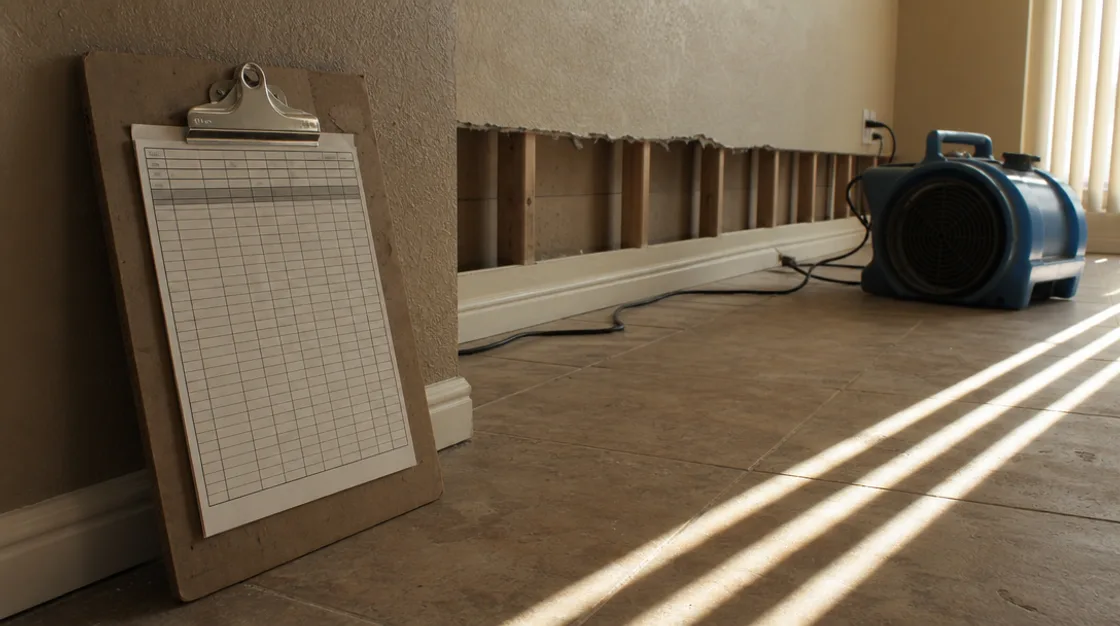
The two clocks, and why mixing them up makes every answer wrong
Ask five restoration companies how long the work takes and you will get five different numbers, because they are quietly answering different questions. One is telling you how long the equipment stays in the house. Another is telling you when you get your kitchen back. Those are not the same span and they are not even set by the same things.
The drying clock is a physics problem. It is set by how much water there is, what it soaked into, how warm the room is, and whether air can reach the wet surface. Nobody controls it by working harder. Three days is common for a contained spill on hard flooring. A week or more is ordinary once water has gone under a floor covering and into the bottom of a wall, and it is longer again when it reached a cabinet run or a stretch of built-in storage.
The rebuild clock is a scheduling problem. It is set by what has to be replaced, whether the materials are held locally, and how many trades have to come back. That one genuinely can be compressed, and it is the one a contract has dates for.
Almost every argument between a homeowner and a contractor about time turns out to be an argument about which of those two clocks somebody quoted at the start.
What actually sets the drying clock
Four things, and only one of them is under anybody's control once the water has stopped.
What the water touched. Tile over a slab gives water up almost immediately. Engineered flooring and laminate hold it and hide it. Drywall wicks it upward from the bottom plate at a rate that depends on the paper facing more than on the room. Insulation inside a wall cavity is the slowest thing in an ordinary house to give water back, and it is also the thing nobody can see.
How long it sat before anything was done. This is the difference between a drying job and a removal job, and it is why the first day matters. The federal environment agency puts the window at 24 to 48 hours before wet material starts growing mold, and names wood, drywall, carpet and furniture as the things at risk. Past that window the question stops being how fast this can dry and starts being how much of it comes out.
Whether air can reach the wet face. A wall that is wet inside the cavity dries when somebody opens it or drills it, and does not dry at all while it is closed and painted. That is the single most common reason a house which has been drying for a week is not drying.
The air the equipment is fighting. A dehumidifier pulls water out of air. In a house that is being cooled, that is a manageable fight. In a house that has been shut up warm through a Moreno Valley afternoon, it is a slower one.
Why nobody can give you a date over the phone, and what they can give you
Nobody can put a number on your job before seeing it, and anybody who does is quoting an average rather than your house. What they can do, and what you should ask for, is a written scope that separates the drying days from the working days.
That distinction is worth more than a single date, because the two halves behave differently when things slip. Drying time cannot be shortened by adding people. Rebuild time usually can. If somebody tells you eight days and it becomes twelve, the useful question is which half moved.
California is unusually helpful here, and it is worth knowing before signing anything. The state contractor licensing board publishes what a home improvement contract has to contain: a written contract is required for any home improvement project over $500, and it has to carry a payment schedule, a completion date, and a statement of who pulls any permit. So the timeline is not a verbal estimate you take on trust. On a job of any size it is a term of the agreement, written down before the work starts rather than after it has slipped.
If you are weighing a quote rather than a schedule, what actually drives a mold remediation price covers the other half of the same decision.
Read the equipment rather than the promise
A drying schedule is legible from the outside once you know what to look at.
Air movers point at wet surfaces, not into the middle of rooms. If they are aimed at open floor and nothing else, either the wet material has already come out or nobody has mapped where the water went. A dehumidifier should be running with the doors and windows of the drying area shut, because its job is to take water out of a closed volume of air and an open window undoes it. Readings should come from the same spots on each visit and be written down, because a moisture number only means something beside yesterday's number from the same place.
The agency's cleanup guidance carries one instruction that is easy to get backwards and worth knowing. If you can already see mold, wait before starting fans or dehumidifiers until the visible growth has been gently cleaned, so the fans do not spread it. Equipment arriving before that step is equipment working against the job.
The stretch of the timeline that belongs to somebody else entirely
In Moreno Valley there is usually a stretch of this timeline that nobody schedules, and it is often the longest one.
Restoration cannot start until the water has stopped, and stopping the water is frequently neither the restoration company's job nor the water company's. Eastern Municipal Water District, which supplies most of the city, publishes its position plainly on its own leak information page: it does not repair leaks on the customer side of the meter, that is the responsibility of the customer, and customers may wish to call a plumber because hidden leaks can be very expensive. That one sentence decides who owns the first stretch of your timeline, and the answer is you.
Even where the leak is on the district's side, the district is candid that its own clock is not instant. Its emergency information page tells customers that every call is evaluated, that a determination is made about whether the repair happens straight away, and that in some cases it can take several days to allow time for proper investigation of the problem and for gathering the proper materials.
Put those together and the real sequence in a Moreno Valley house is often four stages rather than two. Find the leak. Get a licensed plumber to stop it, which is not our trade and we do not route it as ours. Dry what the water reached. Then rebuild. A homeowner who has been told five to seven days has usually been quoted the third stage alone, and the gap between that number and what they actually live through is stages one and two, which nobody put on the schedule.
That is not a reason to distrust the number. It is a reason to ask which stage it covers, and to start stage one the day you notice, because it is the only stage where waiting has no upside at all. If you are not yet certain that is what you have, the signs of a slab leak is written for the stage before this one, and water damage restoration in Moreno Valley covers what happens to the water that already moved.
The three numbers underneath every timeline
| What | The figure | Source |
|---|---|---|
| Time before wet material starts growing mold | 24 to 48 hours | US EPA, A Brief Guide to Mold, Moisture and Your Home |
| Materials the EPA names as at risk after one day wet | Wood, drywall, carpet and furniture | US EPA, Flood Cleanup to Protect Indoor Air and Your Health |
| What a California home improvement contract has to carry | A completion date, in writing | California Contractors State License Board |
Send the details and get a scope with dates on it
A photograph of the wet area, a note of what the water was and roughly when it started, and the rooms it reached. That is enough for a restoration pro working in this city to come back with a written scope, and a scope with dates on it is the only timeline worth anything.
How long water damage restoration takes, in short
How long can drywall be wet before mold?
The federal environment agency puts the window at 24 to 48 hours, and names drywall in the list of materials that can start growing mold after a day wet, alongside wood, carpet and furniture. That is a guide rather than a deadline. A sheet of drywall in a closed warm room is at the fast end of it, and the same sheet with air moving across both faces is at the slow end. The useful way to read the number is that the first day is the one where a decision changes the outcome, and the third day mostly changes the price.
How long does it take for mold to grow after water damage?
The same 24 to 48 hour window, and the agency states the mechanism plainly as well: mold may begin growing indoors when mold spores land on surfaces that are wet. Spores are already in the room and always have been. What changes after a leak is that they have somewhere to sit that stays damp. That is why the useful question about a wet floor is never whether there is mold yet, but how long the material underneath has been holding water and whether it is drying or only feeling dry.
What does water damage restoration include?
Four things, in this order. Stopping and removing the water. Taking out material that cannot be dried, which is usually the absorbent things, because the agency's own guidance is that absorbent or porous materials may have to be thrown away if they become moldy. Drying the structure back to a reading that matches a dry part of the same house. Then putting back what came out. Only the last of those is building work, which is why a quote that covers the first three and stops is not wrong, it is half a job, and it is worth asking which half you have.
Is water damage restoration worth it?
That depends entirely on what got wet and for how long, and the honest test is not about money at all. Water that has soaked into the bottom of walls, under a floor covering or into a cabinet base does not go away on its own in this climate. It dries slowly and unevenly and leaves the material behind it changed. If the wet area is small, was clean water, and has genuinely dried within a day or two, watching it is reasonable. If it reached materials that hold water and sat there past that first window, the choice is not between paying and not paying, it is between paying for drying now and paying for removal and rebuild later.
Get a written scope for your Moreno Valley house
Describe what happened and where the water reached. The request goes to a restoration pro working in Moreno Valley, and nothing is booked until you have read what they propose to do.