Water damage categories 1, 2 and 3 explained
Restoration work sorts water into three categories before it does anything else. The number is not a formality and it is not about how much water there is. It is a statement about what the water has been in contact with, and it decides what stays in your house.
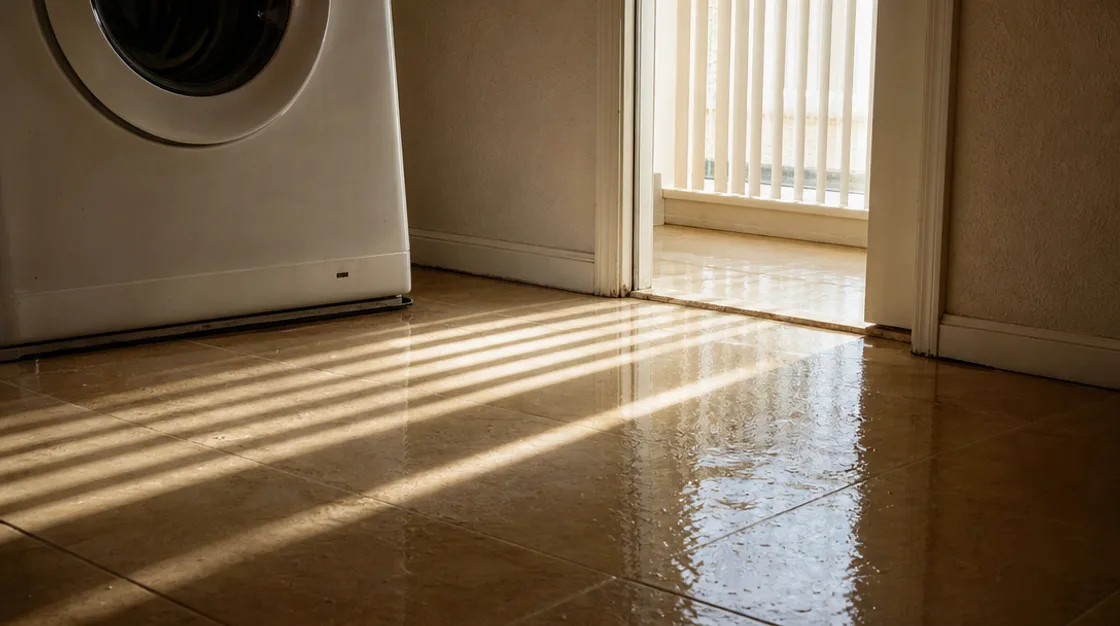
The three categories, in plain words
Restoration work sorts water by what it has been in contact with, not by how much of it there is. A bathtub overflow across a whole floor can be the least serious of the three. A slow seep from somewhere unpleasant into one square metre of carpet can be the most.
Category 1 is clean water. It came from a supply line, a water heater, a burst pipe carrying drinking water, or a fitting on the clean side of an appliance. Nothing has been dissolved in it and nothing has grown in it yet. Most of what it touches can be dried and kept.
Category 2 is used water. It has been through something. A washing machine or dishwasher discharge, an overflow from a fixture with soap and food in it, water from a heater tank that has sat for years. It carries enough biological and chemical load that porous material starts becoming a problem, and cleaning has to happen before drying rather than after.
Category 3 is grossly contaminated water. Sewage, a toilet backup past the trap, water that has come in off the ground outside, or anything that has been standing long enough to have become that. Absorbent material in its path comes out. This is the category people arrive at this page looking for, and it is the one where the decisions are least negotiable.
The federal agency draws the same line without using the numbers
The category numbers are trade shorthand, which is a fair reason to be sceptical of them. What makes them more than jargon is that a publisher with no commercial interest in the answer draws the same distinction in plain language.
The federal environment agency's flood cleanup guidance states that flood water can contain bacteria, chemicals or other hazards which may affect your health. Then, in a note aimed at exactly the person reading this page, it separates the other case out: if your home is damaged by water from a pipe leak or rainwater intrusion, it says, go to the mold guidance instead, because water damage from those events typically presents fewer hazards and affects a smaller area than damage from hurricanes and floods.
That is the whole category system, written by a federal agency in two sentences and without a single number. One kind of water is a hazard question. The other kind is a moisture question. Everything the trade does differently between category 1 and category 3 follows from that split.
Category is not fixed, and that is the part that surprises people
The most common misunderstanding about this system is that a job gets its number at the start and keeps it. It does not. Clean water becomes category 2 and then category 3 by sitting.
Two things move it. The first is time and warmth: the agency's guidance is that mold can grow on wood, drywall, carpet and furniture if they remain wet for more than 24 hours, and that mold may begin growing indoors when spores land on surfaces that are wet. The second is what the water picks up on the way. Clean water that has run through a wall cavity, across a floor that has been lived on, and into a cabinet base full of cleaning products is not clean water any more by the time anybody sees it.
This is the practical reason the first day matters more than the third, and it is the reason a homeowner watching a damp patch to see whether it goes away is often making the decision worse without doing anything. How long water damage restoration takes covers what that clock is doing while nobody is watching it.
What each category actually changes in the room
What comes out. In category 1 most hard material stays and most absorbent material can be dried if it is reached quickly. By category 3 the agency's own line applies without much argument: absorbent or porous materials, such as ceiling tiles and carpet, may have to be thrown away if they become moldy. Carpet pad, particle board, insulation and drywall that has wicked to any height are the usual list.
The order of the work. In category 1 you can dry first. In category 2 and category 3 you clean first, because drying contaminated water in place leaves everything it carried behind in the material. The agency puts the sequence bluntly: use clean water and detergent to physically remove contaminants first, because disinfectants and sanitisers do not work on surfaces that have not been cleaned.
How the air is handled. Category 3 work is done inside containment with the air managed, so that taking the material apart does not move it into the rest of the house. That is a real cost driver rather than theatre, and it is one of the reasons the same square footage prices very differently between categories. It is also the point at which this stops being a job to take on yourself: the agency's flood guidance says it may be best to get help from experienced and qualified people, and the state's own guide to hiring a contractor is where to start on what to ask before anybody opens a wall.
What can be repainted. Very little, and the agency says so directly: paint applied over moldy surfaces is likely to peel. A category 3 room that has been dried, cleaned and painted without the absorbent material coming out will tell you within a season.
All four of those change the scope of the job rather than the trade doing it, which is why the category gets settled on site before anything is priced. What the work involves once it is settled is set out on water damage restoration in Moreno Valley, and where the water sat long enough for growth to start, mold remediation in Moreno Valley covers the removal side of it.
The Moreno Valley half of a category 3 call, and who owns it
A category 3 backup in this city has a first phone call that is not a contractor, and it is not the call most people make.
Eastern Municipal Water District supplies most of Moreno Valley, and it runs the sewer side as well. Its page on reporting a water emergency tells customers it has personnel available to respond to situations involving mainline breaks, service line leaks, sewer blockages and sewer manhole problems, and it asks customers to call and report those immediately, because those calls are how the damage gets found. It also states that each call is evaluated and a determination made about whether the repair happens straight away.
That matters for a category 3 job in a way it does not for a category 1 job. If the backup is coming from the district's line, it is the district's problem to stop and there is a published route to reporting it. If it is in your own lateral or past your meter, it is not, and the district says so elsewhere in the same set of pages: it does not repair leaks on the customer side of the meter.
So the order for a sewage backup in a Moreno Valley house is: report it, so that if it is theirs somebody is already moving on it; get somebody licensed onto your own side if it is not; keep people out of the affected rooms while the water is still arriving; and only then worry about what comes out of the room. The restoration decision is real, and it is fourth.
One more local point, because it is the piece a slab house changes. There is no lower level here for contaminated water to run down into and sit. It runs flat and sideways under the floor covering instead, which means the area affected by a category 3 event is usually wider and shallower than people expect, and the edge of it is frequently under something rather than visible. That is why the useful instrument is a moisture map of the whole floor rather than a look at the obvious patch, and it is why the signs of a slab leak is worth reading if you are not sure where your water is coming from in the first place.
Where the line actually gets drawn, and by whom
| What | The figure | Source |
|---|---|---|
| What the agency says flood water can contain | Bacteria, chemicals or other hazards | US EPA, Flood Cleanup to Protect Indoor Air and Your Health |
| How it classes a pipe leak or rainwater by comparison | Fewer hazards, smaller area | US EPA, Flood Cleanup to Protect Indoor Air and Your Health |
| What happens to absorbent material that has gone moldy | May have to be thrown away | US EPA, Mold Cleanup in Your Home |
Not sure which one you are looking at
Send a photograph and a line about where the water came from. Sorting a category is the first thing anybody does on site, and it is the difference between a drying quote and a removal quote, so it is worth getting a real answer rather than guessing from a website.
Water damage categories 1, 2 and 3 explained, in short
What is the difference between remediation and restoration?
Remediation is getting the problem out. Restoration is putting the room back. On a water job they run together, which is why the words get used as if they mean the same thing, but they are billed and scheduled separately and it is worth knowing which one a quote covers. Remediation is the extraction, the removal of material that cannot be saved, the cleaning and the drying. Restoration is the drywall, the paint, the flooring and the trim that follow it. A quote that ends at a dry, opened-up room has covered remediation only.
How can you tell if you have mold after water damage?
Mostly by looking and by smelling, and the agency is direct that in most cases, if visible mold growth is present, sampling is unnecessary. Look at the bottom of walls rather than the middle, at the back edge of a cabinet base, under the lip of a floor covering, and at anything paper faced that was wet. A musty smell in a closed room that clears when the room is opened and returns when it is shut is the classic sign of growth somewhere you cannot see yet. What you cannot tell by looking is how far it goes behind a surface, which is what an on-site assessment is for.
Will insurance pay for water damage?
That is between you, your policy and your insurer, and anybody on a website answering it is guessing about a document they have not read. What is worth doing either way is keeping the record. Photograph the water and the source before anything is moved. Write down when it started, if you know, and when you found it. Keep removed material or photograph it in place and again once it is out. Ask for moisture readings as a dated log rather than as a verbal update. Those are records of what happened rather than claims about what is covered, and they are worth having whichever way the conversation goes.
Get the category sorted before anything gets thrown out
Tell us what the water was, where it reached, and roughly when. The request goes to a restoration pro working in Moreno Valley, and the scope comes back in writing before any material moves.