What drives the cost of mold remediation
Every page that answers this question with a range is averaging a bathroom patch against a whole wall of a house. What is worth having instead is a way to read the estimate in front of you, because a quote you can take apart is a quote you can compare against another one.
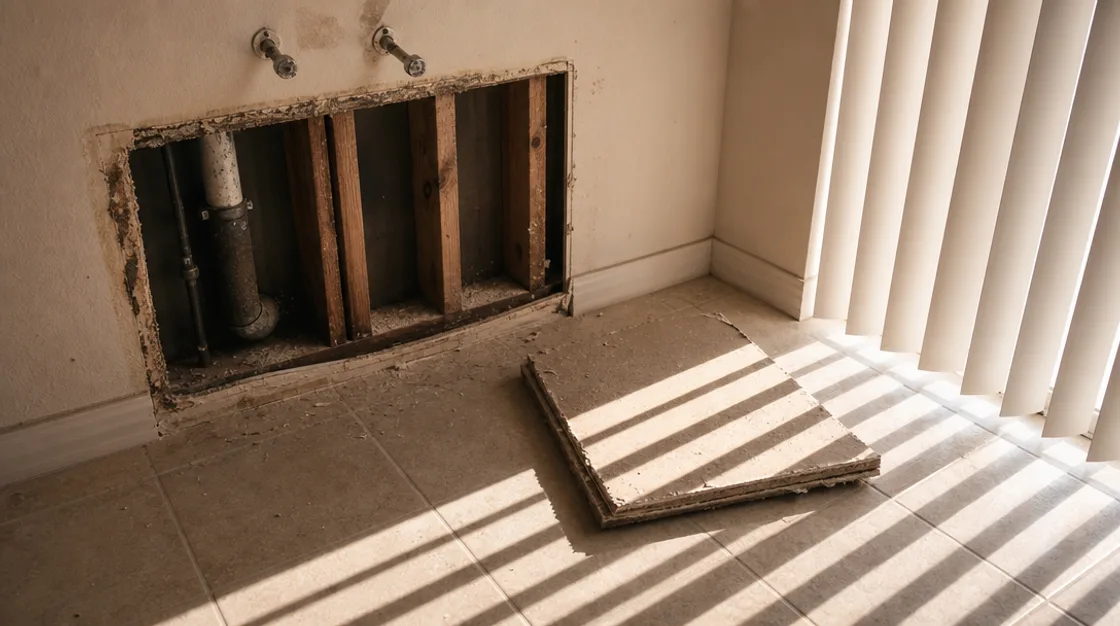
Why there is no average, and why every page that gives you one is guessing
A mold remediation job can be one afternoon behind a bathroom vanity or a fortnight with a hallway opened up along its length. Both are called mold remediation. Averaging them produces a number that describes neither, and then a homeowner takes that number to a quote and cannot work out why the two disagree.
What is worth having instead is a way to read the estimate in front of you, because a quote you can take apart is a quote you can compare. That is a different question from what moves the price, and it is the one this post answers. If you want the drivers on their own, the mold page sets out the five things that move a mold remediation number.
What a mold quote is actually made of
Most quotes look like one number because they are printed as one number. Underneath, almost every one of them is the same five line items measured in different units, and knowing the unit is what lets you argue with the total.
The affected area, in square feet. Ask what number they used and how they arrived at it, because the visible patch and the affected area are rarely the same size. Growth on the face of a wall is fed by moisture in the cavity behind it, and the cavity is usually wet further than the stain is dark. A quote built on the stain will grow once the wall is open. A quote built on a moisture map usually will not.
The split between cleaning and removal, in those same square feet. These carry different unit rates and the second is several times the first, so the proportion matters more than the total area does. Hard, non-absorbent surfaces clean. Absorbent ones frequently do not, and the federal environment agency puts it plainly: absorbent or porous materials, such as ceiling tiles and carpet, may have to be thrown away if they become moldy. Carpet pad, particle board, insulation and paper-faced drywall are the usual casualties in a house here.
Containment, charged as a setup rather than by area. Sheeting, taped edges, a machine handling the air, and a controlled way in and out. It is close to a fixed cost, which is why it dominates a small quote and disappears into a large one. It is also the line people assume is padding, and it is not.
Equipment, charged as a day rate times a number of days. Ask for both numbers separately. A single equipment figure hides whichever half is unusual, and the day count is the part that slips.
The rebuild, which is often not in the document at all. Remediation ends with a dry, clean, opened-up room. Somebody still has to close it: drywall, tape, texture, paint, trim, flooring. On a small job that is a day. On a large one it is most of the money. Whether it is included is a question worth asking in exactly those words.
The six questions that make two quotes comparable
Two totals cannot be compared. Two quotes broken down like this can, and none of these questions requires you to know anything about the trade.
- What area did you measure, and did you measure it with a meter or by eye?
- How much of that area are you cleaning, and how much are you removing?
- Is containment in this price, and is it one charge or one per room?
- What is the equipment day rate, and how many days have you assumed?
- Is the rebuild in this document, in a second document, or not yours at all?
- Has the water source been fixed, and if not, whose estimate covers finding it?
Question six is the one people leave out and the one that decides whether any of the others hold. Remediating a wall while the pipe behind it is still leaking buys a few months. The agency's whole position rests on the point that the key to mold control is moisture control, so a quote should say what the moisture source was and whether it has been dealt with. In this city that is frequently a plumber rather than a restoration company, which means a separate trade and a separate bill, and how long water damage restoration takes covers what that split does to the schedule as well as to the budget.
The paperwork is the one part you do not have to negotiate, because California has already fixed it: a written contract above $500, a deposit capped at $1,000 or ten percent, and no payment running ahead of the work performed. The mold page sets those rules out in full under reading a quote.
A scale marker worth having before any of it
The federal environment agency publishes a threshold that is useful for working out whether you are looking at a job at all. If the moldy area is less than about 10 square feet, roughly a three foot by three foot patch, it says that in most cases a homeowner can handle the work themselves.
That is the agency's advice to homeowners and it is not ours. A service that matches you with a contractor is not the right party to tell you to do the work yourself, and we are not telling you that. It is quoted because it is a published sense of scale from somebody with nothing to sell, and it is roughly where the trade starts treating a patch as a contained project with the five line items above rather than as a wipe-down.
The one part of a Moreno Valley mold bill that has a published route back
This next part applies to a specific and very common case, and it is missing from every other cost guide written for this city: mold caused by a leak nobody could see.
If a concealed leak ran for weeks under your floor, you paid for that water twice. Once on the water bill, and once again in what it did to the building. The second half is yours. The first half is not necessarily.
Eastern Municipal Water District, which supplies most of Moreno Valley, publishes a concealed leak adjustment request form for customers who have recently had a concealed leak on their property. On the same set of pages it tells customers to go looking for a leak if their use has landed in the excessive or wasteful tiers of its water budget, which is exactly the bill shape a hidden leak produces.
So the sequence worth following, in order, is: take the meter reading and the bill before anything is repaired, because that is the evidence the adjustment is assessed on. Keep the plumber's invoice describing what was found and when it was fixed. Submit the district's form. And treat that as entirely separate from the remediation quote, because the district's process is about water volume and has nothing to say about drywall.
It will not pay for the mold work. What it does is take one line off a bill that arrived at a bad moment, and it is a published, ordinary process rather than a favour, which is more than can be said for most of what gets promised to homeowners in this situation. If you want the work itself explained before the price, mold remediation in Moreno Valley sets out what the six stages actually are and what a scope should name.
The published numbers a mold quote sits inside
| What | The figure | Source |
|---|---|---|
| Value above which California requires a written contract | $500 | California Contractors State License Board |
| Legal cap on the deposit before work starts | $1,000 or 10 percent, whichever is less | California Contractors State License Board |
| What may be paid ahead of the work beyond that deposit | Nothing | California Contractors State License Board |
Get an itemised number instead of a range
A photograph of the patch, the room it is in, and a line about what was wet and roughly when. That is enough for a restoration pro working in this city to price your house rather than an average of other people's, and to itemise it the way the rest of this page describes.
What drives the cost of mold remediation, in short
How much does your water bill increase if you have a leak?
Enough that the bill is often the first thing that notices. Eastern Municipal Water District bills on a water budget with tiers, and its own guidance is to check for leaks if your use has landed in the excessive or wasteful bands. There is no single figure, because it depends entirely on the size of the leak and how long it ran before anybody spotted it, but a concealed leak that runs for a full billing cycle is a large and obvious jump rather than a subtle one. The district also publishes a concealed leak adjustment request form, which is worth knowing about before you pay the bill and forget it.
What kills mold growth naturally?
Nothing you can spray fixes a wet building, and that is the honest answer rather than a sales one. The agency's line is that the key to mold control is moisture control. Vinegar, tea tree oil and bleach all do something to what is on the surface, and none of them does anything to the water in the material underneath, which is what the growth is living on. Worse, the agency notes that paint applied over moldy surfaces is likely to peel, and the same principle applies to anything else laid over the top. If the material is porous and it stays wet, it comes back.
What is the average cost to remove mold?
There is not one that means anything, and a page quoting you a range has averaged a one metre patch of bathroom ceiling against a hallway wall opened up for its whole length. What you can do instead is make the quote comparable, which is what the rest of this page is about: ask for the affected area in square feet, how much of it is being removed rather than cleaned, whether containment is included, what the equipment day rate is and how many days it assumes, and whether the rebuild is in the same document. Two quotes broken down that way can be compared against each other. Two totals cannot.
Get a mold remediation quote for your own house
Send what you can see and what you know about the water. The request goes to a restoration pro working in Moreno Valley, and nothing is booked until you have read the scope and the number.