Mold remediation in Moreno Valley
Mold in a Moreno Valley house is almost always a water story that nobody spotted in time. This page is about the work of putting it right, what decides the price, and what to ask before you sign anything.
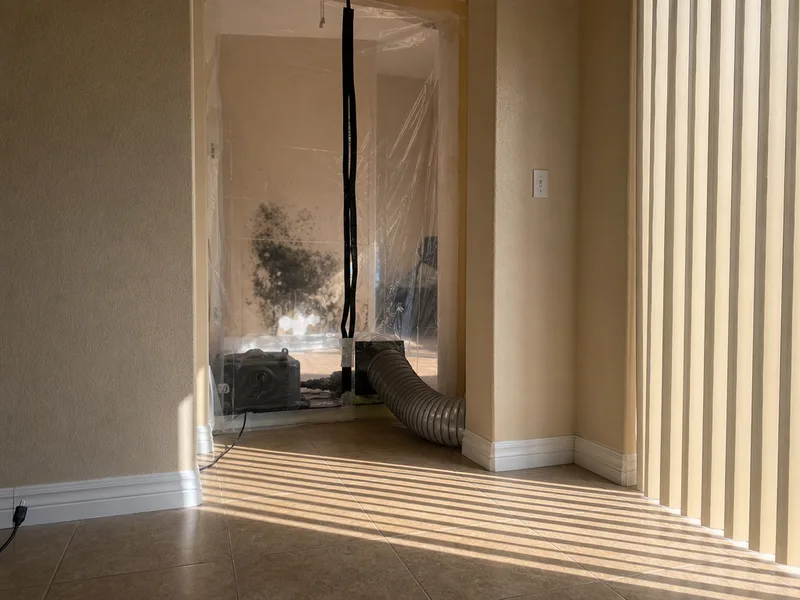
Mold removal and mold remediation, and why one page covers both
Both phrases get typed into a search box in roughly equal numbers in this city, and they describe the same visit. The trade says remediation because removal is only the middle of the job. What actually happens is a sequence, and the reason to know the sequence is that it is how you read a quote.
- Find where the water came from, and stop it.
- Contain the area so that taking the growth apart does not move it around the house.
- Take out the material that cannot be cleaned.
- Clean what can be cleaned.
- Dry the space until the readings match a dry part of the same building.
- Put it back.
A quote that describes step three and nothing else is quoting a fraction of the work. That is not necessarily dishonest, and sometimes it is exactly what is wanted, but you should know which one you are buying. The EPA puts the same point at the front of its own guidance in one sentence: the key to mold control is moisture control. Everything on this page follows from that.
Why mold here is a water story rather than a weather story
Growth needs water on a surface for long enough. Not humidity in the abstract, water. The EPA describes it as mold spores landing on surfaces that are wet, and puts the practical window at drying water damaged areas and items within 24-48 hours to prevent it starting.
That window is why the calls we see split so cleanly into two kinds. The first kind is the obvious one. Something failed, the room got wet, and either nobody dried it properly or nobody found it for a week. The second kind is the one that surprises people, and it is specific to houses in a climate like this one.
Between June and September the weather station inside the city records seven tenths of an inch of rain across the whole four months. Effectively nothing. So when somebody calls in August about a damp wall or a ring on a ceiling, the water did not fall on the house. It came out of something inside it. In a hot dry inland city, the machinery that makes a house liveable in summer is machinery that handles water.
An evaporative cooler brings a supply line to a unit that usually sits on the roof or in a gable, above a hallway or a bedroom ceiling. Air conditioning does not take water in but it produces it. A working system pulls litres a day out of the air and sends it down a condensate line that runs from an air handler, often in a closet or an attic, across the house to a drain. Both of them fail without making a sound. A float sticks. A line blocks with the dust a dry summer generates in quantity. The overflow goes somewhere nobody looks at, and by the time it shows on the ceiling below it has been wet for weeks.
That is the difference between a mold job that started three days ago and one that started in June, and it is most of what decides how much of the wall is coming out.
Where mold actually turns up in a house on a slab
The ranking pages in this market list mold services by generic room. It is more useful to list it by the way the water got there, because that is what tells you where to look next.
Under and behind a shower or a bath
A shower pan or a tiled joint that has been weeping does not present as water. It presents as a soft patch of skirting in the room next door, or a section of hallway floor that is discoloured along one line. On a single storey the water runs flat and lands at the base of a wall, so the visible problem is frequently in a different room from the leak.
In the air handler closet, and along the condensate line
The most common summer source and the one nobody checks. A blocked or disconnected condensate line dumps into the closet floor, the cabinet base and the wall behind it. Because it happens gradually and the door is usually closed, the first sign is a smell rather than a stain.
In the attic under a rooftop cooler
Roof mounted cooling puts a water connection above the ceiling. A leak there sits in the insulation for a long time before it comes through, and it comes through as a ring rather than a drip.
Behind a dishwasher, a fridge line or a washing machine
The classic slow appliance leak. The tell is a cabinet base that has swollen at the edge, or a floor plank near the machine that no longer sits flat.
At the bottom of a wall after a slab leak
Water that has come up through or under the slab wets the bottom plate of the walls and the underside of whatever is on the floor. Growth starts in the cavity where nobody can see it. If you have already been told you have a slab leak, this is the second half of it, and the diagnostic side is written up in the notes on spotting a slab leak.
At a window head after the winter storms
The one that is genuinely weather. Nearly three quarters of the year's rain falls between December and March here, in a handful of storms rather than steadily, and a window flashing that gets away with it in a light year does not get away with it in a heavy one.
Why we do not test, and why that is a feature
Mold inspection and mold testing are a different trade, done by home inspectors and industrial hygiene firms. We do not offer them, we do not sell them as ours, and we do not route requests for them as though they were part of this service. There are two separate reasons, and the second one matters more than the first.
The first is simply that they are different work with different training behind it.
The second is the conflict. If the same party is paid to find out how much mold you have and then paid to remove it, one of those payments depends on the answer to the other. It does not require anybody to behave badly for that to distort the result. It is a structural problem and the industry's own convention is to keep the two apart.
There is also a plain practical point, and the EPA states it directly. In most cases, if visible mold growth is present, sampling is unnecessary. You can see it. A sample would tell you it is there. What a sample cannot do is tell you whether the number it produces is acceptable, because, in the EPA's words, standards or threshold limit values for airborne concentrations of mold, or mold spores, have not been set. There is no line for a result to be above or below.
Where testing does earn its keep is a genuine unknown. A persistent smell with no visible source, or a dispute between two parties who need an independent record. In both of those, the value comes precisely from the tester having nothing to gain from the answer.
What remediation involves, in the order it happens
Stopping the water comes first, and it is not always our job. If the source is a live plumbing leak, a plumber stops it. If it is a condensate line or a cooler, that is usually a heating and cooling contractor. Remediation that starts before the water stops is remediation you will be buying twice.
Containment is next, and it is the step people underestimate. Taking apart a wet, growing wall without sealing the room first moves the problem into the rest of the house. Containment is sheeting, taped edges, and usually a machine holding the working area at a slightly lower pressure than the rooms around it so that air moves in rather than out.
Removal follows, and what comes out is decided by the material rather than by the look of it. The EPA's line is the useful one here. Absorbent or porous materials, such as ceiling tiles and carpet, may have to be thrown away if they become moldy. Drywall, insulation, carpet pad and particle board cabinet bases hold water inside themselves and cannot be reliably cleaned. Tile, glass, solid timber, metal and painted plaster generally can.
Cleaning is what happens to everything that stays. Surfaces are cleaned rather than sprayed and left. Painting over is not a shortcut and the EPA is blunt about why. Paint applied over moldy surfaces is likely to peel.
Drying is the step that decides whether it comes back. The space has to reach and hold a normal reading, checked with a meter against a known dry part of the same building, not judged by touch. This is where a schedule stretches, and it is the part that cannot be shortened by sending more people.
Rebuild is the last step and often a separate quote. Find out before you sign whether the number you are looking at ends at a bare stud wall or at a painted one. That single question resolves most of the disagreements that happen at the end of these jobs.
What actually drives the price
There is no square foot rate for this and anybody quoting one over the phone is pricing a job they have not seen. Five things move the number, roughly in order of how much they move it.
How much has to come out rather than be cleaned. A patch on a painted plaster wall is a cleaning job. A run of drywall with wet insulation behind it is a removal job, and removal brings a rebuild with it.
How big the affected area is. The EPA's own dividing line is useful as a sense of scale even though it is written for homeowners rather than for pricing. If the moldy area is less than about 10 square feet, in most cases you can handle the job yourself. Above that, and particularly where the water was not clean, it becomes work for somebody with containment equipment.
How hard it is to reach. A wall you can stand in front of is cheaper than the same square footage in an attic over a hallway or inside a closet with a water heater in it.
Whether the water source is fixed. If a plumber has been and the leak has stopped, the job is bounded. If nobody has found it yet, part of what is being quoted is a search.
How long it sat. Two weeks and two seasons are different jobs on the same wall, because time is what decides how far the water travelled through the structure.
The cost question has its own write-up in what actually drives a mold remediation price, and the timing question, which is really a drying question, is covered in how long restoration work takes.
Reading a quote, and the four things California already decides for you
You do not have to take anybody's word for any of this, because the state sets the rules for the paperwork. The Contractors State License Board publishes them and they are worth knowing before the first visit rather than after it.
- A written contract is required for any home improvement job over $500.
- The contract has to name the contractor's business address and licence number.
- The deposit cannot be more than $1,000 or ten percent of the contract price, whichever is less.
- Payments after the deposit cannot run ahead of the value of the work already done, and the contract has to carry a written payment schedule, a completion date and who is responsible for permits.
None of that is advice about who to hire. It is the floor under every quote you will be shown, and a quote that does not meet it is missing something the law says it has to contain. The board's own consumer guidance is at cslb.ca.gov.
What happens after you send the request
You describe what you can see and where the water came from if you know. That goes to a restoration pro working in this city, who comes back with a scope. Which areas, what is being removed, how the space is contained, how long the drying is expected to run, and what the finished state is. You read it, you ask the questions above, and you decide. Nothing is booked and nothing is owed for asking.
If it turns out that what you actually have is a wet house rather than a growing one, start at water damage restoration in Moreno Valley instead, because the drying happens first and the mold question may not arise at all. If it is soot and smoke, that is fire and smoke restoration. All three sit together on the services page.
The three numbers this page rests on
| What | The figure | Source |
|---|---|---|
| Rain between June and September | 0.72 inches | Derived from NOAA U.S. Climate Normals 1991-2020, monthly precipitation at March Air Reserve Base |
| Area a homeowner can usually handle alone | About 10 square feet | US EPA, Mold Cleanup in Your Home |
| Federal limit for airborne mold | None has been set | US EPA, Mold Testing or Sampling |
Send a photograph of what you can see
You do not need to know what it is, how far it goes, or whether it counts as a big job. A picture of the patch, a note of what was wet and roughly when, and where in the house it is, is enough to get a scope and a number back.
Questions about mold remediation in Moreno Valley
Is there a difference between mold removal and mold remediation?
In practice they are the same job under two names, and this page ranks for both because homeowners search both. Remediation is the term the trade uses because taking growth off a surface is one part of six. The rest is finding and stopping the water, removing the material that cannot be cleaned, cleaning what can be, drying the space back to a normal reading, and leaving it in a state where the same thing does not happen again. If a quote you are reading only describes the removal step, ask what happens about the other five.
Do I need a mold test before anyone starts work?
Usually not, and the EPA says so plainly: in most cases, if visible mold growth is present, sampling is unnecessary. What a test would tell you is that there is mold, which you can already see, and a number that has nothing to compare it to. Where testing genuinely helps is when nobody can find the growth but the smell is unmistakable, or when a landlord and a tenant disagree about what is there. In those cases the person who runs the test should not be the person quoting to remove it.
Will homeowners insurance pay for mold remediation?
That is between you, your policy and your insurer, and anybody on a website telling you the answer is guessing about a document they have not read. What we can tell you is what makes the conversation go better. Photograph the growth and the water source before anything is touched. Write down when the leak started, if you know, and when you found it. Keep the removed material or photograph it in place and again once it is out. Ask for the moisture readings as a dated log rather than as a verbal update. Those are records of what happened, and they are worth having either way.
What does black mold mean, and does it change the work?
It usually means somebody has looked at a dark patch and reached for the phrase. Colour does not identify a species and no homeowner decision hangs on the answer, because the work does not change: the water is what caused it, the water is what has to stop, and the material that will not clean up comes out regardless of what shade it is. Be wary of a quote that prices itself off the word rather than off the square footage, the containment and the materials involved.
How long does mold remediation take in a Moreno Valley house?
A small containment in one bathroom is often a couple of days including the drying. A run of wall along a hallway where a condensate line has been leaking for a season is a week or more, because the removal is the quick part and the drying and the rebuild are not. The honest answer is that nobody can give you a number before seeing the extent, and the useful question to ask instead is which parts of the schedule are drying time, since that is the part that cannot be rushed by adding people.
How do you avoid getting scammed on mold remediation?
Four things, and none of them requires trusting anybody. First, refuse to buy a number off a phone call: California requires a written contract on any home improvement job over $500, and it has to carry a payment schedule, a completion date and the contractor's licence number. Second, read the deposit against the legal cap of $1,000 or ten percent of the price, whichever is less. Third, be suspicious of anybody who arrives to test and then quotes to remove, because that is one party being paid to find work for itself. Fourth, treat any air quality number you are shown with care, because the EPA states that no standards or threshold limit values for airborne concentrations of mold have been set, so there is nothing for that number to fail.
Get a mold remediation quote in Moreno Valley
Describe what you are looking at and where the water came from if you know. The request goes to a restoration pro working in this city, and nothing is booked until you have read the scope.