Signs of a slab leak, and what happens next
A slab leak is a supply line failing where you cannot see it, under or inside the concrete a house sits on. It rarely announces itself. It turns up as a bill, a sound, a warm patch or a damp edge, and the useful skill is knowing which of those is worth acting on.
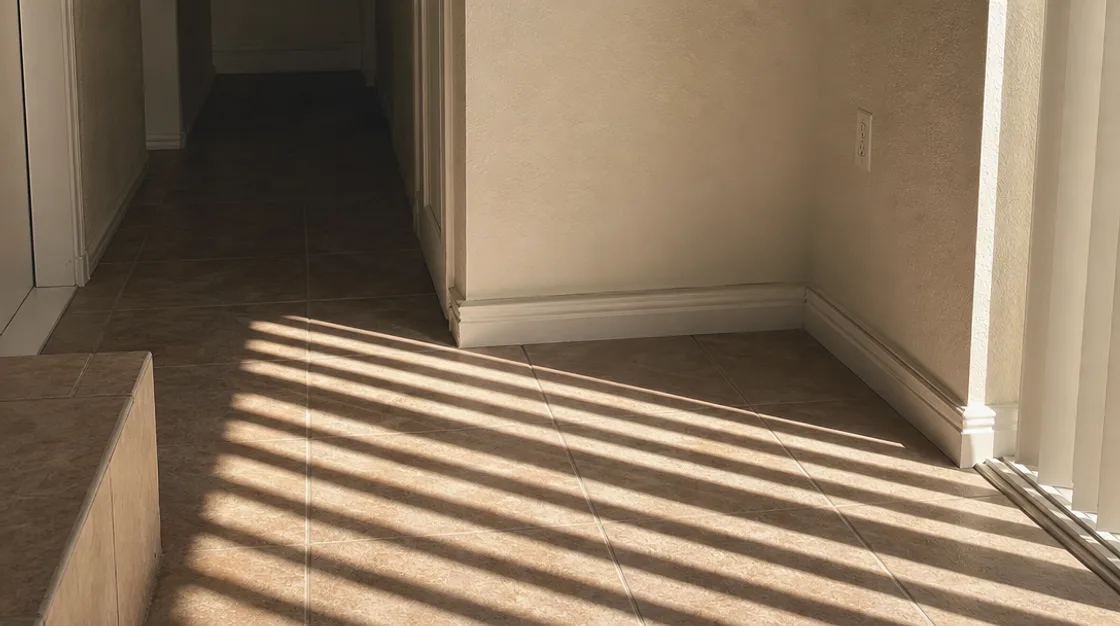
What a slab leak actually is, in a house built this way
Houses here sit directly on concrete. The water lines that feed the house either run inside that concrete or underneath it, and when one of them fails there is nothing between the leak and the ground but the slab itself.
That geometry is the reason a slab leak behaves so differently from a burst pipe under a sink. There is no lower storey for water to run down into and be noticed. Some of it goes into the ground, which is why a leak can run for months without anybody seeing a drop. The rest travels flat, along the underside of the floor covering, until it finds somewhere to come up. Which is usually not where the pipe failed.
So the first thing to unlearn is the expectation of a puddle. Most slab leaks in this city are found by a bill, a sound, a temperature or a smell, long before anybody finds water.
The signs, in the order they are usually worth trusting
The bill moved and your habits did not. This is the single most reliable early sign, because a slab leak runs continuously. If a billing cycle has jumped without a new appliance, a new person in the house, a new lawn or a hot month of watering, that is worth two hours of investigation.
Running water with everything off. Stand in a quiet house with every fixture closed and listen at the floor, particularly near where the main comes in. A constant faint hiss or a running sound with no source is not normal and it is not the air conditioning.
A warm patch on a tiled floor. A failed hot line under the slab heats the concrete above it. It is unmistakable underfoot and it does not move, which is what distinguishes it from sunlight.
A damp edge that keeps coming back. Carpet that is dark at one edge, a skirting board or baseboard that has gone soft at the bottom, a cabinet base that swells, tile grout that stays darker along one line. These are all the same thing: water that travelled sideways and came up where the floor was slightly low.
A musty smell in a closed room. Damp material under a floor covering smells before it shows. A smell that is strong when a room has been shut and clears when it is opened is telling you something under the surface is wet.
Cracking that has recently changed. Concrete moves when the ground under it changes moisture content. A hairline crack in a doorway or a tile line that has opened over a season, alongside any of the above, is corroborating rather than diagnostic on its own.
The test the water district publishes, and it costs nothing
Before calling anybody, do the test the supplier itself recommends. Eastern Municipal Water District publishes it on its check for leaks page for its own customers, and it is the closest thing to a definitive home answer that exists.
Read your water meter, then leave the property with no water being used at all for two hours, then read it again. If the meter has changed at all in that window, you probably have a leak. The district is explicit that this means checking a two hour period with nothing drawing water.
Then narrow it. The leak information page describes the finer instrument: most meters carry a small mechanical leak indicator below the reading dials, and some digital faces flash a plus or minus symbol when water is passing through. Turn off every faucet and water-using appliance indoors and out, and look at it directly. If the indicator is moving, water is going through the meter with nothing drawing it.
One more free step before you conclude the leak is under the slab: the district also publishes the toilet dye test, which is putting a drop of food colouring in the tank and checking the bowl fifteen minutes later. A leaking flapper is by far the most common cause of a meter that will not sit still, it is a cheap part, and it is worth eliminating before anybody starts talking about opening a floor.
Whose job it is, stated by the people who would know
This is the sentence that decides who you call, and it is worth quoting rather than paraphrasing. On that same leak information page the district states that it does not repair leaks on the customer side of the meter, that this is the responsibility of the customer, and that customers may wish to call a plumber because hidden leaks can be very expensive.
So the chain is clear and it has two links.
A licensed plumber locates the leak and stops it. That is a plumbing trade, it involves work on the line itself, and it is not what this site is for. We do not offer it, we do not route it, and a restoration company arriving to talk about the pipe is answering a question that is not theirs.
Then there is the water that already moved, and that is the half this site exists for. It is a different job with different equipment: mapping how far the water travelled under the floor, getting the wet material dry or out, and putting the room back. It usually starts after the plumber has finished, and water damage restoration in Moreno Valley is where that half is set out.
The reason it cannot wait for a convenient week is that the material has its own clock. The federal environment agency puts the window at 24 to 48 hours before wet material starts growing mold, and a slab leak has usually been running long before anybody noticed it, so by the time the plumber has finished the question is frequently how much comes out rather than how fast it can dry.
The part nobody in the chain does for you, and it matters later
There is a gap in the sequence above, and it follows directly from the split between the two trades.
Because the water company will not touch a customer-side leak, and because the plumber's job ends when the pipe stops leaking, there is nobody in the sequence whose job it is to record what the water did. The plumber documents the repair. The district documents the volume. Nothing in that chain documents the damage, and the damage is the expensive half.
So do it yourself, and do it before the floor comes up, because the moment a plumber starts cutting, the evidence of how far the water spread is destroyed by the work that had to happen anyway.
Photograph the wet area from the doorway before anything is moved, so the frame shows the room and not just the patch. Photograph the meter, showing the reading, on the day you first suspected it. Keep the plumber's invoice describing what was found and where, because that is the only document that will ever say when the leak started to somebody's satisfaction. Photograph any material that comes out, in place first and again once it is out. Write down the dates: when the bill jumped, when you noticed, when it was stopped. And ask any restoration contractor for the moisture readings as a dated log from consistent points, rather than as a verbal update, because a reading only means something beside the previous one from the same place.
None of that is a claim about what anybody will pay. It is a record of what happened, which is the thing that is impossible to reconstruct afterwards and trivial to capture at the time. The same applies to whoever you bring in next: California's guide to hiring a contractor sets out what the state already requires to be in writing, and a written scope is one more dated record of the condition the house was in. It is also, incidentally, what makes the water half of the bill arguable: what actually drives a mold remediation price covers the district's published route for a concealed leak, and that route is assessed on exactly these records.
If the water has already been sitting long enough that you are wondering what is growing under the floor, the three water damage categories explains what changes about the material once it does.
The one test worth doing before you call anybody
| What | The figure | Source |
|---|---|---|
| How long to leave the water off before reading the meter | Two hours | Eastern Municipal Water District, Check for Leaks |
| What a moving leak indicator with everything off means | Water passing through the meter | Eastern Municipal Water District, Leak Information |
| Who repairs a leak on the customer side of the meter | The customer, not the district | Eastern Municipal Water District, Leak Information |
Already found water where it should not be
If the leak is stopped and the damage is the problem, that is the half we handle. Send a photograph of the wet area and a note of how long you think it was running, and a restoration pro working in this city can tell you how far it likely travelled before anybody opens anything up.
Signs of a slab leak, and what happens next, in short
Should a water meter move when not using water?
No, and that is the whole point of the test. Most meters carry a small mechanical leak indicator below the reading dials, and some digital faces show a plus or minus symbol that flashes when water is passing through. Turn off every faucet and water-using appliance on the property, indoors and out, and look at it. If it is moving, water is going through your meter while nothing is drawing it. That is either something left on that you have forgotten, or a leak on your side of the meter. Those are the only two options, which is what makes the test worth two hours of your evening.
How much does it cost to repair water damage in a home?
Two separate bills, and confusing them is why the answers online vary so wildly. There is the plumbing bill for finding and stopping the leak, which depends on where the line runs and how much floor has to come up to reach it. Then there is the restoration bill for the water that already moved, which depends on how far it travelled, what it soaked into, and how long it sat before anybody found it. The second is the one this site is about, and the honest way to get a number for it is an on-site assessment with a moisture map, because the wet area under a floor is almost always larger than the visible patch.
Get the damage half looked at properly
A plumber stops a slab leak. What follows it is a drying and rebuild question, and that is the part this site is for. Describe what you are seeing and where, and the scope comes back in writing.