Fire and smoke restoration in Moreno Valley
A house fire leaves three separate problems behind and they get solved in a fixed order. This page is about what that order is, who pulls the permit, and what a scope should say before you agree to it.
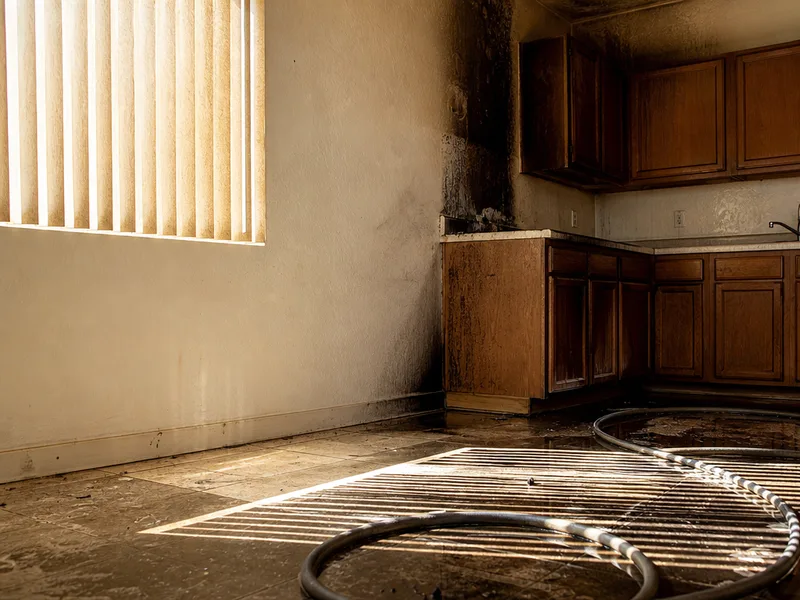
What fire and smoke restoration covers, and in what order
Three problems come out of one event, and they do not queue politely. A house that has had a fire in it has water in the floors, residue on every surface the smoke reached, and a hole where the burnt part used to be. They are dealt with in a fixed order, and the order is not the order people expect.
Water is first. Whatever the fire did, it stopped when it was put out, and the thing that is still getting worse afterwards is the water. It is soaking into flooring and drywall while the soot sits patiently doing very little. Extraction and drying therefore run first, and on a single storey house that has consequences described further down this page.
Soot is second, because it keeps working. Residue is acidic and it etches. Metal fittings, glass, grout and painted finishes all take permanent damage from soot that is left in place for weeks, and a surface that could have been cleaned in the first fortnight sometimes cannot be in the second month.
Odour is third, and it can only be third. Smell lives in materials, so removing the smell means removing or treating the material carrying it. Deodorising a room that still holds smoke-laden carpet pad is money spent on a result that will not last the summer.
Rebuild is last, and it is frequently a different contract with a different party. That is where most of the surprises in these jobs live, so it is worth settling in the first conversation rather than the last one.
The water the hoses left, on a house with nowhere below it
Suppression puts a lot of water into a building in a short time, and in this city it lands on a floor with nothing under it. Houses here sit on a concrete slab, so there is no lower level for the water to drain into and be dealt with separately. It runs flat instead, follows the slab to wherever the floor is slightly low, and gets under the bottom plate of every wall it reaches on the way.
The practical effect is that the wet part of a fire job is usually much larger than the burnt part, and frequently in different rooms. A kitchen fire can leave a bedroom at the far end of a hallway with a wet wall base and no visible connection to what happened. That is one of the reasons the water half of the work is handled as its own scope, with its own drying schedule and its own meter readings, rather than as a footnote to the fire.
The same equipment and the same principles apply as in any other wet house, and they are set out in full on water damage restoration in Moreno Valley. What changes on a fire job is that the water is carrying soot, which puts it into a dirtier category than a supply line failure does. What that means for which materials get dried and which get removed is explained in the three water damage categories.
Soot is not dirt, and that is why the cleaning is different
Household cleaning products are designed for household soil. Soot is combustion residue, and what it consists of depends on what burned, which is why an experienced contractor asks that question first.
A fast, hot fire in framing and furnishings leaves a dry, powdery residue that sits loosely and can be drawn off surfaces before anything wet touches them. Wet smoke, from a slower fire with less oxygen, leaves a sticky, strong smelling film that smears if it is wiped and has to be dealt with chemically. A kitchen fire involving cooking oil leaves a thin protein residue that is nearly invisible, does not look like damage at all, and is the one that makes a house smell for a year.
Three consequences follow for a homeowner reading a quote.
- The first pass on dry soot should be dry. Wiping a powdery residue with a wet cloth turns a removable layer into a stain in the paint.
- The cleaning method should be named per surface rather than as a single line. Sealed timber, painted drywall, tile and metal do not take the same treatment.
- Ceilings matter more than they look. Heat and smoke go up, and a ceiling that has been ignored is frequently the reason a finished room still smells.
Contents, and what leaves the house
Belongings are normally handled as a separate inventory, and much of it leaves the property, because cleaning items in a room that is still being stripped means cleaning them twice. Ask for three things in writing. What is being taken, where it is being stored, and what the plan is for each category.
What is recoverable is decided by material and exposure rather than by appearance. Hard non-porous items generally clean up. Clothing and household textiles usually do, given the right process. Upholstered furniture and mattresses that have taken heavy smoke often do not, because the residue is inside the fill where nothing reaches it. Paper, books and photographs are a specialist question and should be flagged early rather than discovered in a skip.
The thing to avoid is a contents line in a quote that says a single word and a single number. It is the part of the job with the widest spread of possible outcomes and it deserves the most detail.
Odour, and why it comes back in the summer
Smoke odour is not a smell hanging in a room. It is residue absorbed into porous materials, and heat drives it back out. That is why a house that seemed finished in February can start smelling again in July when the structure warms up, and why the season here makes this more noticeable than it would be somewhere cooler.
The sequence that holds up is to remove what is carrying it, clean what is staying, treat the surfaces, and only then seal and repaint. Sealing early is the shortcut that gets taken most often, and it works for about a season. If a quote reaches painting before it has explained what happened to the carpet pad, the insulation and the ceiling, that is worth a question.
The permit, and who is responsible for pulling it
The rebuild half of a fire job is construction, and the City of Moreno Valley requires a permit to modify an existing structure. Its Building and Safety Division issues the permit, carries out the plan check and does the inspections. That is not a formality to be handled quietly at the end. An inspection sign-off is the record that the work was done to code, and its absence turns up years later at the point of sale.
California requires a home improvement contract to state who is responsible for obtaining permits, along with a written payment schedule and a completion date, on any job over $500. So the answer to who pulls the permit is not something to establish by conversation. It is something the document you are signing is required to contain. If it does not, that is the first question, before the price.
What to ask before you agree to anything
- Which rooms are in scope, including the ones that took smoke and not fire, and why each is on the list.
- Whether the water work, the soot cleaning, the odour work, the contents inventory and the rebuild are one contract or several, and who holds each one.
- What the drying schedule is and who reads the meters. Timing on this half is covered in how long restoration work takes.
- Where the contents are going and when they come back.
- Who applies for the permit, and when.
- Whether the deposit sits inside the state's cap of $1,000 or ten percent of the contract price, whichever is smaller.
Federal guidance on the first days after a house fire, including what to do about securing the property and replacing documents, is published by the U.S. Fire Administration.
If what you have is water or growth rather than fire
Plenty of the requests that arrive on this page turn out to belong somewhere else, and that costs nothing to sort out. If the fire was small and the real damage is the water, start at water damage restoration in Moreno Valley. If a wall has been wet for a season and there is growth on it, mold remediation is the page for that. All three sit on the services page with the reasons each one exists.
Three rules that apply to the rebuild before anyone quotes it
| What | The figure | Source |
|---|---|---|
| Permit to modify an existing structure | Required | City of Moreno Valley, Community Development Department, Building and Safety Division |
| Job value above which the contract must be written | Over $500 | California Contractors State License Board, home improvement contracts |
| Largest deposit allowed | $1,000 or 10 percent, whichever is less | California Contractors State License Board, home improvement contracts |
Say what burned and what the hoses reached
A photograph from the doorway of each affected room, a note of which rooms took smoke without taking fire, and whether the water got into a hallway or a neighbouring room. That is enough for somebody to write you a scope.
Questions about fire and smoke in Moreno Valley
What order does fire and smoke restoration happen in?
Water first, then soot, then odour, then rebuild. That surprises people, because the fire is the dramatic part, but the water the hoses left is the thing that gets worse by the hour while everything else waits. Soot removal comes next because soot keeps etching surfaces for as long as it sits on them. Odour work only makes sense once the material carrying the smell has gone. The rebuild is last and is usually a separate line, sometimes a separate contractor.
Can smoke damage a room that did not catch fire?
Yes, and this is the most commonly underestimated part of the job. Smoke travels with air, so it goes wherever the air went: up a hallway, into a wardrobe with the door shut, through a return duct into a bedroom at the other end of the house. A room can be visually untouched and still hold the smell in the paint, the carpet and the contents. Any scope worth reading names which rooms are being treated and why, including the ones that look fine.
What happens to furniture and belongings after a fire?
Contents are usually handled as their own inventory and often leave the house, because cleaning them in a room that is still being worked on undoes the cleaning. What comes back depends on the material rather than on how bad it looks. Hard surfaces and most textiles are recoverable, upholstery and mattresses often are not, and anything porous that has taken heavy soot tends to be a write-off. Ask for the inventory in writing and ask where the items are being stored.
Why does the smell come back weeks later?
Because odour is not a smell sitting on a surface, it is residue in materials, and heat brings it out again. A room that seems clean in February can announce itself in July when the house warms up. That is why sealing and painting before the residue is dealt with is a false economy, and why a scope that jumps straight to repainting is one to ask questions about.
Who is responsible for the permit on a fire rebuild?
The city requires a permit to modify an existing structure, and its Building and Safety Division issues them, does the plan check and does the inspections. Who applies for it is a question the contract has to answer: California requires a home improvement contract to state who is responsible for obtaining permits. If the document you are reading does not say, that is not a small omission, because an unpermitted rebuild becomes your problem at the point you sell the house.
How much does fire and smoke restoration cost in Moreno Valley?
It is the widest range of the three jobs on this site, because a single scorched wall in a kitchen and a house that lost a roof are the same category and nothing like the same number. What is comparable is the paperwork. Insist on a written scope that separates the water work, the soot cleaning, the odour work, the contents inventory and the rebuild, because those five things are frequently quoted by different parties. A single figure covering all five is not a figure you can check against anybody else's.
Longer notes on this
Get a fire and smoke restoration quote in Moreno Valley
Tell us which rooms are involved and what stage things are at. The request goes to a restoration pro working in this city, and you get a written scope back before anything is agreed.